
later-, lateral-, -late, -lat, -lation, -lative
(Latin: to bear; to carry)
It would appear that the icebergs are ablating faster than scientists had anticipated.
After a heavy rain, the top soil ablates from the field and runs off into the stream.
2. In medicine, to amputate or otherwise to destroy a biological function, for example by removing a bodily tissue with a laser, or by means of burning with electric heat: The doctor ablated the abnormal number of warts that had formed on Colleen's body with electrocautery.The doctor indicated that she would ablate the lump from Tanya's leg.
After Patrick's crushed foot was ablated in an accident, he learned to walk and to run with a prosthetic foot and shoe.
2. The erosive processes by which a glacier is reduced by wearing or wasting away: Melting and the breaking off of a mass of ice from its parent glacier or ice shelf are ablations that icebergs undergo during the summer months.
3. In aerospace, the dissipation of heat generated by aerial friction: There are ablations in atmospheric reentries of spacecrafts or missiles with the use of melting heat shields.
2. Tending to be removed or vaporized at very high temperatures: The ablative material on the rocket cone fell off.
3. In grammar, applied to one of the cases of the noun in Latin and some other Indo-European languages: The ablative case is the removal, separation, or taking away and indicates the direction away from, or time when.
Grammatical "cases" are changes in form that are made of nouns or pronouns to reflect how they are used in sentences. For example, the noun "men" is changed to "men's" and the noun "woman" is changed to "women's" to show possession. Nouns in English once had several case forms, but the only one used today is the possessive case.
Pronouns continue to change case forms to show their relations to the rest of the elements in a sentence. The three cases of pronouns are "nominative", "objective", and "possessive" cases.
2. The outer surface of a spacecraft or missile: "Ablation" is the erosion of the protective outer surface, or ablator, of a spacecraft or missile resulting from aerodynamic heating caused by travel at hypersonic speeds during reentry through the atmosphere.
The ablators on the spacecraft were welded into place using a specialized metal that would withstand great heat.
2. Relating to or bordering the Atlantic Ocean: There are many lovely little towns and villages in France along the Atlantic coast.
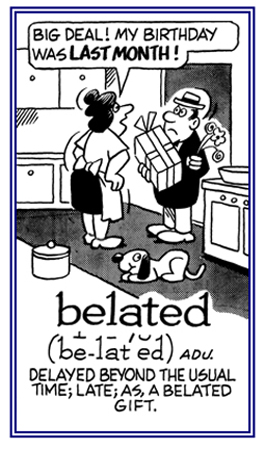
Mildred received belated recognition for her scientific discovery of energy-saving devices.
Go to this Word A Day Revisited Index
so you can see more of Mickey Bach's cartoons.
Its name is a combination of California University + tron (Cal+U+tron) in tribute to the University of California, Ernest O. Lawrence's institution and the contractor of the Los Alamos laboratory. It was developed during the Manhattan Project and was similar to the cyclotron invented by Lawrence.
2. A device that separates isotopes by ionizing the sample, accellerating the ions in a strong electric field, and then passing them through a strong magnetic field.2. To bring together pieces of information and compare them in detail in order to arrange information that has been collected into a sensible order.
3. To verify the correct sequencing and completeness of the pages in a book.
4. Etymology: from Latin collatus, conferre, "to bring together", from com-, "together" + -latus, "to bear, to carry".
2. The assembling of pieces of paper in proper numerical or logical sequence; especially, the sections of a book before binding.
3. The technical description of a book, including its bibliographical details and information about its physical construction, or the act of compiling such a description.
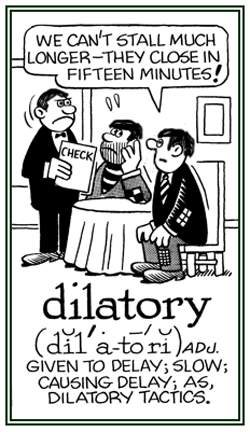
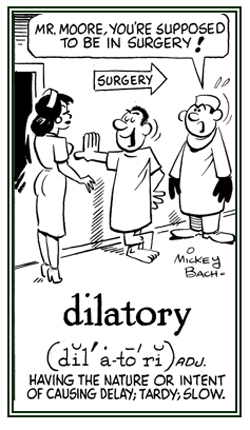
2. Using cautious slow strategy to wear down the opposition; and so, avoiding direct confrontation and deferring a decision: The congressman, Mr. Gould, used a dilatory strategy to keep the bill from being passed.
3. Etymology: from Latin dilatorius; from dilator, "procrastinator", from dilatus, the past participle form of differe, "to delay".
Go to this Word A Day Revisited Index
so you can see more of Mickey Bach's cartoons.
Go to this Word A Day Revisited Index
so you can see more of Mickey Bach's cartoons.
2. The enactments of a legislator or legislature; the whole body of enacted laws.
