
You searched for:
“automaton”
automation, automaton
automation (aw" tuh MAY shuhn) (noun)
1. The technique, method, or system of operating or controlling a process with electronic devices, reducing human intervention to a minimum: The door uses a system of automation so you don't have to push it open.
2. The self-moving transfer of one unit of a complex industrial assembly to a succession of machines, each of which completes another stage in a manufacturing process: Modern automobile companies are using more automation than were used decades ago.
2. The self-moving transfer of one unit of a complex industrial assembly to a succession of machines, each of which completes another stage in a manufacturing process: Modern automobile companies are using more automation than were used decades ago.
automaton (aw TOM uh tuhn) (noun)
1. Anything capable of spontaneous movement or action: Silvia had an incredible automaton, or robot, that was vacuuming the rugs in the living room.
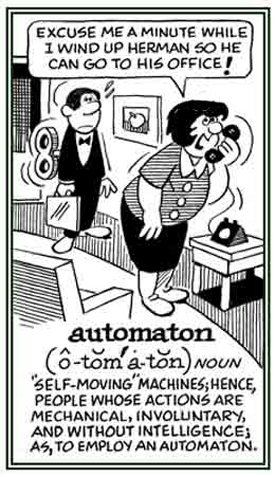
2. A person who acts in a mechanical or machinelike way: Hans was behaving like an unfeeling automaton.
2. A person who acts in a mechanical or machinelike way: Hans was behaving like an unfeeling automaton.
Lorena's uncle was so surprised to see what the new automation was able to do, that he was moving like an automaton; that is, moving as if he were in a daze of amazement.
This entry is located in the following units:
auto-, aut-
(page 14)
Confusing Words Clarified: Group A; Homonyms, Homophones, Homographs, Synonyms, Polysemes, etc.
(page 9)
1. A self-operating machine or mechanism, especially a robot: The Smiths bought an automaton, a special device which would mow the lawn in their garden all by itself.
2. A mechanical figure or contrivance constructed to act as if by its own motive power: Tommy got an automaton for his birthday, which looked like a little soldier and could be operated by winding it up so it would walk around in his living room.
3. Someone who acts or responds in a mechanical or apathetic way: Only an automaton wouldn't have noticed the threat of the thunderstorm.
4. A person or animal that acts in a monotonous, routine manner, without active intelligence: The whole football team sat around after the game, like automatons, lifeless and depressed after losing the last game of the season.
5. A mechanism that can move automatically or without an external motive force; such as, an android: The cell phone that Janet has can be considered to be an automaton in that it responds to encoded instructions.
© ALL rights are reserved.
Go to this Word A Day Revisited Index
2. A mechanical figure or contrivance constructed to act as if by its own motive power: Tommy got an automaton for his birthday, which looked like a little soldier and could be operated by winding it up so it would walk around in his living room.
3. Someone who acts or responds in a mechanical or apathetic way: Only an automaton wouldn't have noticed the threat of the thunderstorm.
4. A person or animal that acts in a monotonous, routine manner, without active intelligence: The whole football team sat around after the game, like automatons, lifeless and depressed after losing the last game of the season.
5. A mechanism that can move automatically or without an external motive force; such as, an android: The cell phone that Janet has can be considered to be an automaton in that it responds to encoded instructions.
Go to this Word A Day Revisited Index
so you can see more of Mickey Bach's cartoons.
This entry is located in the following unit:
auto-, aut-
(page 14)
Word Entries containing the term:
“automaton”
stochastic automaton, probabilistic automaton
A device, with a finite number of internal states, that scans words over a finite alphabet, with the next state determined according to probabilistic functions of the current input word.