
You searched for:
“arrogate”
abrogate, arrogate, derogate, delegate, delegate, delicate
abrogate (AB ruh gayt") (verb)
1. To abolish or to annul by authority; to nullify, to cancel: Henry associated himself with those who believe that Congress should abrogate the current tax law.
2. Not doing that which is required of a person or a group of people: The banking officials were accused of trying to abrogate their duties.
2. Not doing that which is required of a person or a group of people: The banking officials were accused of trying to abrogate their duties.
arrogate (AIR uh gayt") (verb)
1. To claim, to take, to appropriate, or to assume for oneself without right; as when a person will determine certain privileges for himself: Monroe did indeed arrogate to himself the powers of a general.
Some U.S. Presidents have decided to arrogate the power of congress to declare war.
2. To assign or to attribute to another person without justification: Neil accused the woman next door of wanting to arrogate to herself the power to punish people.derogate (DER uh gayt") (verb)
1. To take away or to detract: Senator Johnson was warned that such a statement will derogate his reputation.
2. To say or to suggest that someone, or something, is not worthy of respect or is not important: There were times when the man's wife would derogate him for not achieving better pay from his company.
2. To say or to suggest that someone, or something, is not worthy of respect or is not important: There were times when the man's wife would derogate him for not achieving better pay from his company.
delegate (DEL i git) (noun)
Someone who is authorized or sent to speak and act for others; representative, as at a convention: Every state will send a delegate to the convention.
delegate (DEL i gayt") (verb)
To entrust (authority, power, etc.) to a person acting as one's agent or representative; entrust, assign, give over, charge, commit to the care of: Cheryl wants to delegate her power of attorney to her nephew.
A delegate is someone who is sent with authority to represent another or others; to delegate work or authority is to transfer or to send it to another person.
delicate (DEL i kit) (adjective)
1. Pleasing in its lightness, mildness, subtlety, etc. (a delicate flavor, odor, color, etc.); fine, dainty, exquisite, elegant: Queen Anne wore a long gown of delicate silk.
2. Easily damaged, spoiled, fragile, frail, perishable; dainty: The plate was so delicate that Sarah was afraid to wash it for fear of breaking it.
3. Frail, feeble, debilitated, weakened; infirm, unwell, sickly, ailing: Marie and Jamie were concerned about their little girl's delicate condition.
4. Palatable, savory, delicious, appetizing, luscious: Debra, the hostess, presented a tray of delicate food to her guests.
5. Soft, muted, subdued: Ted and Cheryl had the walls of their apartment painted with a delicate blue color.
6. Exquisite, minute, detailed: Clyde and Donna admired the delicate workmanship on the bronze doors.
7. Tactful, tasteful, diplomatic, careful, sensitive, refined: Jessie Brown, the public relations manager, handled the situation in a delicate manner.
2. Easily damaged, spoiled, fragile, frail, perishable; dainty: The plate was so delicate that Sarah was afraid to wash it for fear of breaking it.
3. Frail, feeble, debilitated, weakened; infirm, unwell, sickly, ailing: Marie and Jamie were concerned about their little girl's delicate condition.
4. Palatable, savory, delicious, appetizing, luscious: Debra, the hostess, presented a tray of delicate food to her guests.
5. Soft, muted, subdued: Ted and Cheryl had the walls of their apartment painted with a delicate blue color.
6. Exquisite, minute, detailed: Clyde and Donna admired the delicate workmanship on the bronze doors.
7. Tactful, tasteful, diplomatic, careful, sensitive, refined: Jessie Brown, the public relations manager, handled the situation in a delicate manner.
The female senator decided to leave her senatorial seat after she abrogated a decision that would arrogate her right to become a delegate of a congressional committee when a political opponent felt the need to derogate her because of her delicate physical condition.
This entry is located in the following units:
-cate
(page 1)
Confusing Words Clarified: Group A; Homonyms, Homophones, Homographs, Synonyms, Polysemes, etc.
(page 1)
arrogate (AIR uh gayt") (verb), arrogates; arrogated; arrogating
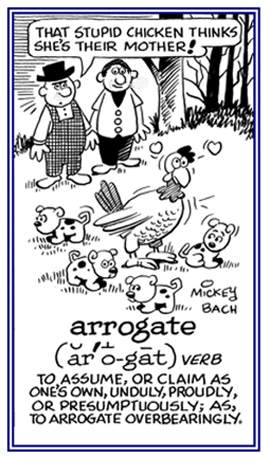
1. To claim, to take, to appropriate, or to assume for oneself without a right to do it: Bruce arrogated to himself the powers of a military General in his position as the CEO of the company.
© ALL rights are reserved.
© ALL rights are reserved.

© ALL rights are reserved.
Go to this Word A Day Revisited Index
Some presidents have arrogated to themselves the power of Congress to declare war.
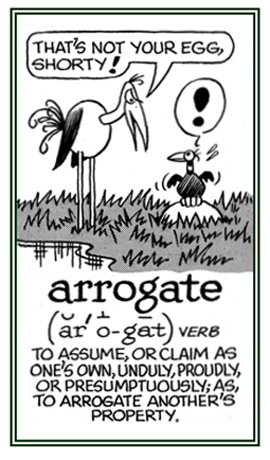
2. To assign or to attribute to another person without justification: Judge Hendricks accused Jane of arrogating to herself the power and the right to punish people.Go to this Word A Day Revisited Index
so you can see more of Mickey Bach's cartoons.
This entry is located in the following units:
-gate +
(page 1)
rog-, roga-, -rogate, -rogation, -rogatory
(page 1)
Word Entries at Get Words:
“arrogate”
To claim, to take, to appropriate, or to assume for oneself without a right to do so; to unduly claim as one's own. (3)
This entry is located in the following unit:
Word a Day Revisited Index of Cartoons Illustrating the Meanings of Words
(page 14)