
You searched for:
“antidote”
anecdote, antidote
anecdote (AN ik doht") (noun)
An interesting incident or brief history; a short narrative; sometimes, a humorous account: Scott, have you noticed that many public speakers begin their talks with a humorous anecdote?
Jane told an anecdote about her early childhood.
antidote (AN ti doht") (noun)
1. A remedy to counteract poison; an antitoxin: Doctors rushed an antidote to the boy who was bitten by a snake.
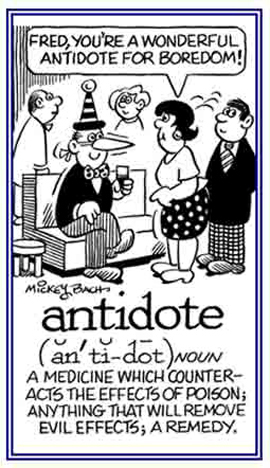
2. Anything that works against an unwanted condition; a remedy or a cure: A hobby is considered a good antidote for boredom and for keeping our minds active.
2. Anything that works against an unwanted condition; a remedy or a cure: A hobby is considered a good antidote for boredom and for keeping our minds active.
Is there an antidote for strychnine poisoning?
Be sure to spell and pronounce anecdote properly. Don't confuse it with antidote; for example, James told an anecdote about his Canadian travels.
Does the doctor have an antidote for the food poisoning our friend got when he ate at the restaurant?
This entry is located in the following units:
anti-, ant-
(page 1)
Confusing Words Clarified: Group A; Homonyms, Homophones, Homographs, Synonyms, Polysemes, etc.
(page 6)
1. A remedy, remedies, or other agents used to neutralize or to counteract the effects of a poison: The doctor at the clinic administered an antidote for the child who was bitten by a snake.
2. An agent that relieves or counteracts: James found that jogging for an hour a day was the perfect antidote for the stresses of his job.
3. Etymology: from Greek antidoton, and from Latin antidotum; from anti-, "against" + didonai, "to give".
© ALL rights are reserved.
Go to this Word A Day Revisited Index
2. An agent that relieves or counteracts: James found that jogging for an hour a day was the perfect antidote for the stresses of his job.
3. Etymology: from Greek antidoton, and from Latin antidotum; from anti-, "against" + didonai, "to give".
Go to this Word A Day Revisited Index
so you can see more of Mickey Bach's cartoons.
This entry is located in the following units:
anti-, ant-
(page 4)
dat-, dos-, dot-, dow-, don-, dit-
(page 1)
Word Entries containing the term:
“antidote”
1. A specific compound or mixture which, when administered, which prevents or retards the absorption of a poison: "In the laboratory, the scientist developed a mechanical antidote for the virus that was spreading among the cattle in the area."
2. A remedy to counteract the effects of a poison or toxin: "The ambulance driver administered the mechanical antidote to the snake bite victim to retard the effects of the toxin during the trip to the hospital."
2. A remedy to counteract the effects of a poison or toxin: "The ambulance driver administered the mechanical antidote to the snake bite victim to retard the effects of the toxin during the trip to the hospital."
"The mechanical antidote is administered by mouth, intravenously, or sometimes on the skin, and it may work by directly neutralizing the poison."
This entry is located in the following units:
dat-, dos-, dot-, dow-, don-, dit-
(page 5)
mechano-, mechan-; mechanico-; machin-
(page 3)
Word Entries at Get Words:
“antidote”
A remedy or an agent that relieves or counteracts a condition or situation. (1)
This entry is located in the following unit:
Word a Day Revisited Index of Cartoons Illustrating the Meanings of Words
(page 11)